
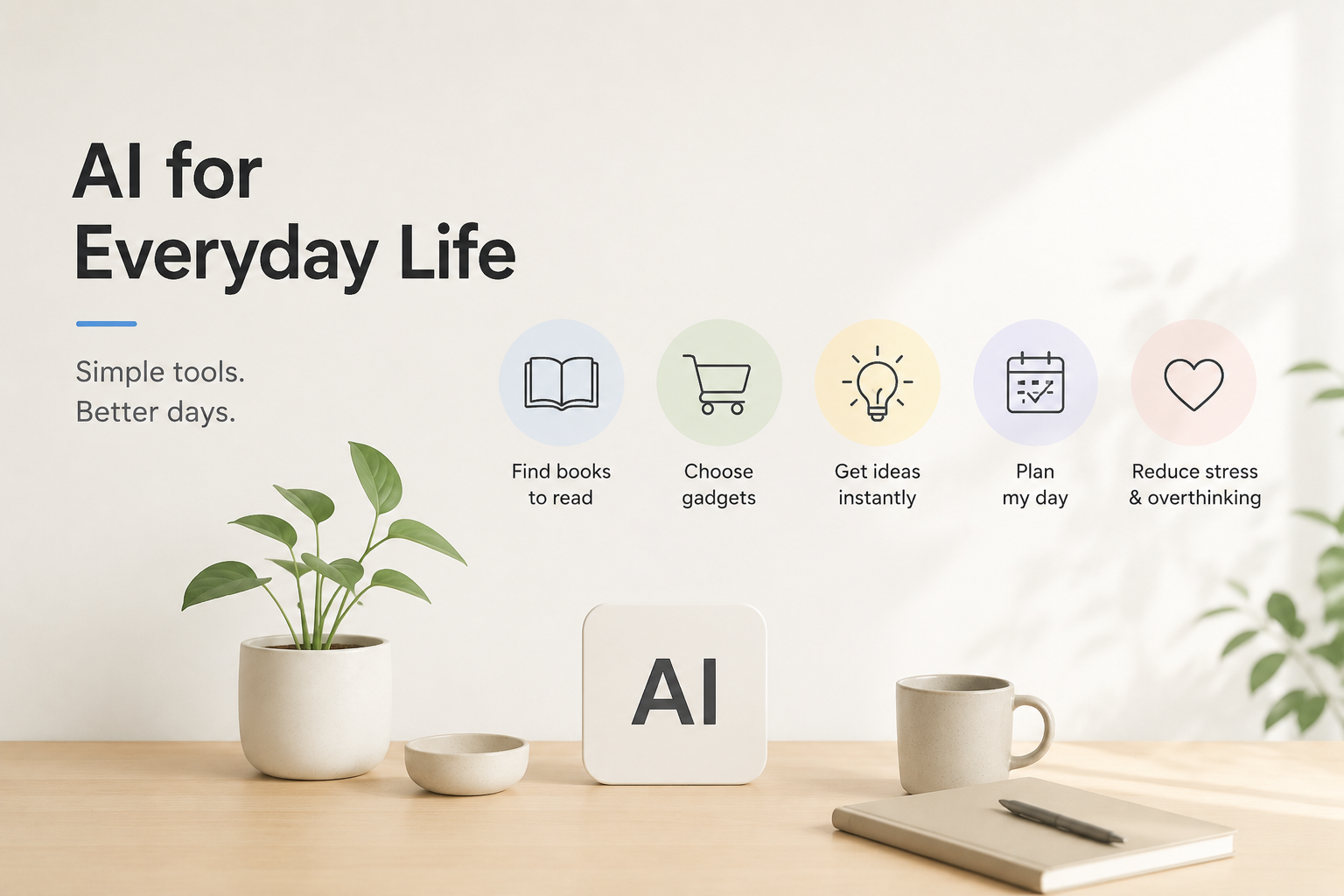
AI is often seen as a tool for work.
But that’s not where it makes the biggest difference.
The real value of AI is in your everyday life.
Small tasks. Small decisions. Small stress.
When you use AI well, your life becomes simpler, lighter, and more organized.
This guide focuses on how AI can improve your daily life.

1. Reduce Mental Load (Stop Thinking Too Much)
One of the biggest daily struggles is thinking too much.
What to cook.
What to do next.
What to choose.
AI can reduce that.
Try:
“Give me 3 simple dinner ideas”
“What should I do today if I feel tired?”
You don’t need perfect answers.
You just need direction.
I personally use this to avoid decision fatigue.
2. Make Daily Routines Easier
Routines are good, but hard to maintain.
AI helps you keep things simple.
Try:
“Create a simple morning routine”
“Give me a 10-minute cleaning plan”
No overplanning.
No complicated systems.
Just something you can actually follow.
3. Turn Overwhelm into Clarity
Sometimes everything feels too much.
Instead of organizing it yourself:
“Help me organize my thoughts”
“Break this into small steps”
AI turns chaos into something manageable.
4. Improve Communication in Daily Life
Not just work – even daily communication.
Try:
“Make this message sound kind”
“Rewrite this in a softer tone”
This helps in:
- Family communication
- Friends
- Everyday messages
Small changes, big difference.
5. Support Learning Without Stress
Learning doesn’t need to be hard.
Try:
“Explain this in simple English”
“Teach me this step by step”
You learn naturally, without pressure.
6. My Personal Story: Finding a Forgotten Song
Have you ever had a song stuck in your head, but you couldn’t remember the name or the artist? Normal search engines need exact words. AI doesn’t.
Personally, I had an amazing experience with this. A few years ago, my daughter broke a bone, and I had to drive her to school early every morning. I was nervous driving in the dark, early hours for weeks. During one of those stressful morning drives, a song came on the radio that completely captivated me.
I didn’t know the title, and I only caught a tiny fragment of the lyrics (which, as it turned out, I had actually misheard). Later, I opened ChatGPT and typed what I remembered:
“It’s a song sung by a man, with a vibe like this… and I think the lyrics are something like [misheard lyrics]. Do you know it?”
To my amazement, ChatGPT instantly found it: “Whataya Want from Me” by Adam Lambert. It was indeed the perfect soundtrack for those crisp, early mornings.
Even today, whenever I hear that song, the emotions of those weeks – the early morning chill, my anxiety, and the quiet moments with my daughter – come rushing back. Music connects us to our memories, but it was AI that rescued that memory for me when my own brain couldn’t fill in the blanks.
A Simple Mindset Shift
Most people try to use AI to do more.
That’s not the point.
Use AI to feel better, not just work faster.
- Less stress
- Fewer decisions
- More clarity
That’s the real value.
Conclusion
AI is not just a productivity tool.
It’s a lifestyle tool.
If you use it well, it can:
- Reduce stress
- Simplify your day
- Improve your quality of life
Start small.
Use it when things feel difficult.
And let AI make your life a little easier.
Quick Questions
Do I need to use it all the time?
No. Just use it when you need help.
I personally use AI to make small decisions easier, like:
– finding books to read
– choosing gadgets when I feel stuck
– finding a forgotten song from a fuzzy memory